Victor advises he has placed the buoys at the Cranberry Pond.
Next Sullivan’s and we will be in business.
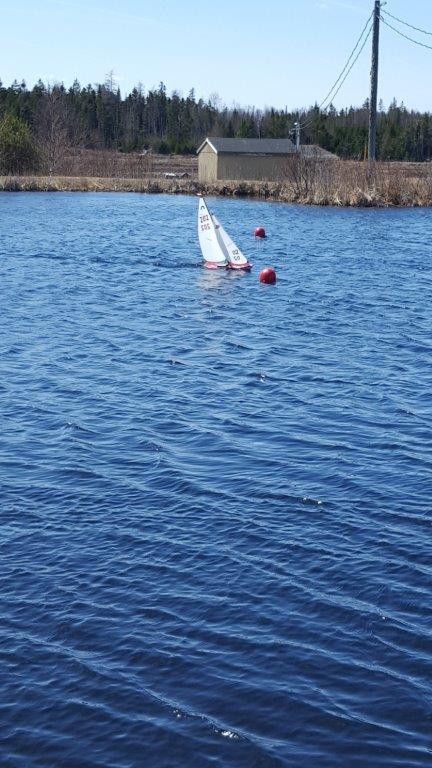
Victor advises he has placed the buoys at the Cranberry Pond.
Next Sullivan’s and we will be in business.
Click here to download some information on servos that several of our members have suggested would be informative. Servos
Our own sailing partner Janice Anderson was the winner in a 26 boat fleet in Florida earlier this month.

1 – Janice Anderson
2 – Ron Lacroix
3 – Doug Jones
4 – Kurt Martin
5 – Bill Croft

When it comes to the subject of sportsmanship, I have two favorite quotes that I
recommend to anyone looking for guidance. The first is from one of Stuart Walker’s
many books. He wrote: “Winning is the object of the game, but it is not the object of
playing the game.” The second quote is from Paul Elvstrom, the Great Dane, who once
said, “You haven’t won the race if in winning the race you have lost the respect of your
competitors.”
It’s amazing how often these statements ring true for me. In fact, whenever I start to get
too obsessed with winning, I take a deep breath and try to remember them. I also think
about sportsmanlike role models and examples of fair play.
When I was a member of US Sailing’s Sportsmanship Committee, it was refreshing to
read dozens of letters each year about people who were nominated for sailing’s national
sportsmanship award. A few years ago the trophy went to Scott Steele, one of America’s
top boardsailors. At the Goodwill Games, Scott had helped his closest competitor,
Grzegorz Myszkowski of Poland, get reinstated after being incorrectly scored OCS. As a
result, Myszkowski won the gold medal and Steele got the silver.
“The number one rule in my book is honor,” said Steele. “What’s most important to me
in sailboat racing is that the competition is fair – that everyone is given an equal chance
to win. I hope everyone sails with this feeling.” Steele is one of the vast majority of
racing sailors who, like Elvstrom, do not believe in “winning at any cost.” They try their
hardest to win each race because that’s the goal (as Walker points out), but they
participate in the sport for many additional reasons besides coming in first.
To me, sportsmanship includes fairness, courtesy, friendliness and many more qualities
that are just as important on shore as on the water. The bottom line on good
sportsmanship in sailing, as in most other parts of life, is the Golden Rule. In other words,
“Do unto others as you would have others do unto you.” If you always treat your
teammates, your competitors and everyone else involved with the sport as you would like
to be treated yourself, then you won’t have to worry about sportsmanship. Here are some
practical ideas on how you and your friends can be good sports and encourage a more
positive atmosphere in your fleet and club.
Compliment your competitors when they make a good move or sail a good race. Nothing
feels better than acknowledgement and appreciation from your fellow competitors. Don’t
just say “Good going” to the first couple of boats, because they’ll hear that a lot. You’ll
make a much bigger impact if you notice what someone in the middle or back of the fleet
did well, and appreciate that. “Hey Joan,” you might say, “you played the shifts almost
perfectly on that first beat.” I know I’d feel pretty good if someone said that to me.
Abide by and enforce the rules. It’s clear that winning is a major objective of sailboat
racing. Unfortunately, some sailors are tempted to overstep the boundaries of the rules to
attain this end. That’s why it’s important to commit ourselves to sailing within the rules.
When you play fair and square, you will win just as many races, and I guarantee the
respect you get from your competitors will be much greater.
Another part of being a good sport is taking responsibility for enforcing the rules. We all
want to be nice guys who don’t make waves. But our sport is a self-policing one. If we
don’t enforce the rules out there, no one will.
Sailing is a great sport because it puts the question of sportsmanship squarely in our own
hands. In most cases, we don’t have referees who force us to follow the rules and
penalize or fine us when we don’t. That’s why we must continue doing things like those
mentioned above. If you treat other people with respect on the race course, they’ll treat
you with respect, too. That not only increases your chances of getting a few breaks in the
race, but it will make you more successful in the rest of your life too.
David Dellenbaugh
Southport Sailing Association Board Member
National and International Sailing Champion
America’s Cup winner




The first heat on Day 2 was a horror show with high waves and heavy gusts.
Jim’s boat broke down on the way to the line after the rx shorted out. Most skippers did not have C rigs available and even those that did had trouble.
Following that, racing was suspended and we waited many hours for the wind to moderate.
When racing resumed the conditions were still tough and both Halifax boats struggled.
On Day 3 more gusty conditions were the order of the day although B Rigs were OK most of the time. More boat problems and errors dominated the day for our Halifax sailors.
In the end, Boots was last after having to retire from the regatta with hardware issues. Jim fared a little better finishing in the mid 20’s despite taking a number of DNS results for breakdowns.
Our EC-12 fleet needs tpo get serious if we are to improve our performance.
Boots has had a series of boat issues that has mired him in Bronze Fleet all day.
JW had a second in the seeding race and then moved backwards to Bronze Fleet and then back to Silver. JW has got the boat going and if not for a number of stupid errors resulting in penalty turns might be solidly in the Gold Fleet.
The wind is quite heavy and rain and lightning held up the sailing for an hour.
Hope for better results tomorrow.


Jim Goddard is the 2016 HAMYC Club Champion!

2016 HAMYC Club Championship – Final Results