
16
Apr, 2017
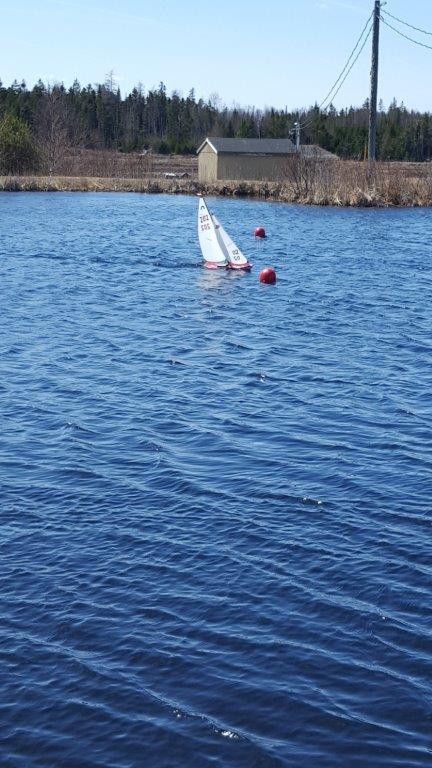
Buoys are in at the Cranberry Pond
Victor advises he has placed the buoys at the Cranberry Pond.
Next Sullivan’s and we will be in business.
A Few Notes on Servos
Click here to download some information on servos that several of our members have suggested would be informative. Servos
The perfect shirt for Boots

Be a Good Sport by David Dellenbaugh
When it comes to the subject of sportsmanship, I have two favorite quotes that I
recommend to anyone looking for guidance. The first is from one of Stuart Walker’s
many books. He wrote: “Winning is the object of the game, but it is not the object of
playing the game.” The second quote is from Paul Elvstrom, the Great Dane, who once
said, “You haven’t won the race if in winning the race you have lost the respect of your
competitors.”
It’s amazing how often these statements ring true for me. In fact, whenever I start to get
too obsessed with winning, I take a deep breath and try to remember them. I also think
about sportsmanlike role models and examples of fair play.
When I was a member of US Sailing’s Sportsmanship Committee, it was refreshing to
read dozens of letters each year about people who were nominated for sailing’s national
sportsmanship award. A few years ago the trophy went to Scott Steele, one of America’s
top boardsailors. At the Goodwill Games, Scott had helped his closest competitor,
Grzegorz Myszkowski of Poland, get reinstated after being incorrectly scored OCS. As a
result, Myszkowski won the gold medal and Steele got the silver.
“The number one rule in my book is honor,” said Steele. “What’s most important to me
in sailboat racing is that the competition is fair – that everyone is given an equal chance
to win. I hope everyone sails with this feeling.” Steele is one of the vast majority of
racing sailors who, like Elvstrom, do not believe in “winning at any cost.” They try their
hardest to win each race because that’s the goal (as Walker points out), but they
participate in the sport for many additional reasons besides coming in first.
To me, sportsmanship includes fairness, courtesy, friendliness and many more qualities
that are just as important on shore as on the water. The bottom line on good
sportsmanship in sailing, as in most other parts of life, is the Golden Rule. In other words,
“Do unto others as you would have others do unto you.” If you always treat your
teammates, your competitors and everyone else involved with the sport as you would like
to be treated yourself, then you won’t have to worry about sportsmanship. Here are some
practical ideas on how you and your friends can be good sports and encourage a more
positive atmosphere in your fleet and club.
Compliment your competitors when they make a good move or sail a good race. Nothing
feels better than acknowledgement and appreciation from your fellow competitors. Don’t
just say “Good going” to the first couple of boats, because they’ll hear that a lot. You’ll
make a much bigger impact if you notice what someone in the middle or back of the fleet
did well, and appreciate that. “Hey Joan,” you might say, “you played the shifts almost
perfectly on that first beat.” I know I’d feel pretty good if someone said that to me.
Abide by and enforce the rules. It’s clear that winning is a major objective of sailboat
racing. Unfortunately, some sailors are tempted to overstep the boundaries of the rules to
attain this end. That’s why it’s important to commit ourselves to sailing within the rules.
When you play fair and square, you will win just as many races, and I guarantee the
respect you get from your competitors will be much greater.
Another part of being a good sport is taking responsibility for enforcing the rules. We all
want to be nice guys who don’t make waves. But our sport is a self-policing one. If we
don’t enforce the rules out there, no one will.
- I’m not suggesting you become a sea lawyer – but encouraging rule compliance will
make the game better for everyone. - Offer a prize for sportsmanship at your regattas. If possible, have the competitors vote for the winner of this prize, and give this award as much importance as you do the first-place trophy. Of course, we don’t want people acting sportsmanlike simply to win a prize (it would be nicer if the motivation was internal, not external). But in the short run a sportsmanship prize will get everyone thinking about the subject.
- While we’re on this subject, don’t forget crew prizes, and consider alternative prizes such as “Most improved” and “Top family team.”
- Say thanks to the race committee and regatta organizers. This may seem like a very
obvious thing to do, but if we took a survey of all the race officers around the world, I bet a majority would say they don’t get much appreciation from the sailors. Volunteer race committees, regatta organizers, and juries are the backbone of racing, and it’s almost impossible to give these hard-working people too much credit. I recommend something more than a token thanks at the awards ceremony. Talk to them personally during the regatta and offer words of support and appreciation. You may not agree with every action of a race committee or every decision of the jury, but you can always thank the members for volunteering their time and working hard.
Another good idea is writing a letter of thanks to the membership of the club where
you’ve just sailed a regatta. Thank them for a good time and for all the sacrifices they made to help insure that your regatta was a success. Send your letter to the regatta chairperson (with a note of thanks to him or her as well), and say you wouldn’t mind if your letter was posted on their bulletin board or reprinted in their newsletter. - Nominate someone from your club or fleet for US SAILING’s Sportsmanship Trophy. If you don’t already have one, create a local prize that is given annually to a club or fleet member who has displayed high standards of sportsmanship during the previous year. Then make the winner of your trophy an automatic nomination for US SAILING’s award. This is a great added incentive for recognizing good sportsmen and women in your local area.
- Share your knowledge by being a teacher. Learning and improving are a large part of what our sport is all about, and these happen much more quickly when we work together.
- If you can help someone understand how to sail his or her boat even a little better, then you’ll both “win.” You don’t have to be a “rock star” in order to help other people
become better sailors. No matter what your skill level, there are always some sailors who can learn from you. In fact, you may do a better job if you’re not the class champion, because you’ll be more accessible and less intimidating. - Give other boats the benefit of the doubt. One of the best things you can do while racing is to treat your competitors as you would like to have them treat you. For example, let’s say you’re approaching the jibe mark and a boat that’s overtaking you from behind is pressing for an inside overlap. You may not even be sure yourself if they have gotten an overlap or not. So instead of automatically yelling “No room,” give the other boat a break by saying “Go ahead.” This may cost you a boat or two in the short run, but remember, in the long run you will “reap what you sow”.
- Give praise to the other people in your boat. It’s not uncommon for skippers to be critical of their crew while racing. Unfortunately, negative motivation is not nearly as good as positive reinforcement. So think positively. If you’re a skipper, look for ways to compliment your crew: “Hey, that was a great roll tack.” “Nice job on the pole.” “Good call on the layline.” If you’re a crew, try to find ways to appreciate your skipper like: “Great start!” “Good job steering the waves.” “Way to get inside at the mark.” This type of encouragement will help everyone feel more confident and better about themselves. It also makes it easier to handle a little constructive criticism once in a while. This will improve not only your performance on the race course, but your relationship after the race as well.
- Be a good role model. The primary way for junior sailors and new sailors to learn about what’s sportsmanlike in sailboat racing is from people like you. You can make a difference, so set a good example!
Sailing is a great sport because it puts the question of sportsmanship squarely in our own
hands. In most cases, we don’t have referees who force us to follow the rules and
penalize or fine us when we don’t. That’s why we must continue doing things like those
mentioned above. If you treat other people with respect on the race course, they’ll treat
you with respect, too. That not only increases your chances of getting a few breaks in the
race, but it will make you more successful in the rest of your life too.
David Dellenbaugh
Southport Sailing Association Board Member
National and International Sailing Champion
America’s Cup winner
2016 US EC-12 Nationals Day 1
Boots has had a series of boat issues that has mired him in Bronze Fleet all day.
JW had a second in the seeding race and then moved backwards to Bronze Fleet and then back to Silver. JW has got the boat going and if not for a number of stupid errors resulting in penalty turns might be solidly in the Gold Fleet.
The wind is quite heavy and rain and lightning held up the sailing for an hour.
Hope for better results tomorrow.

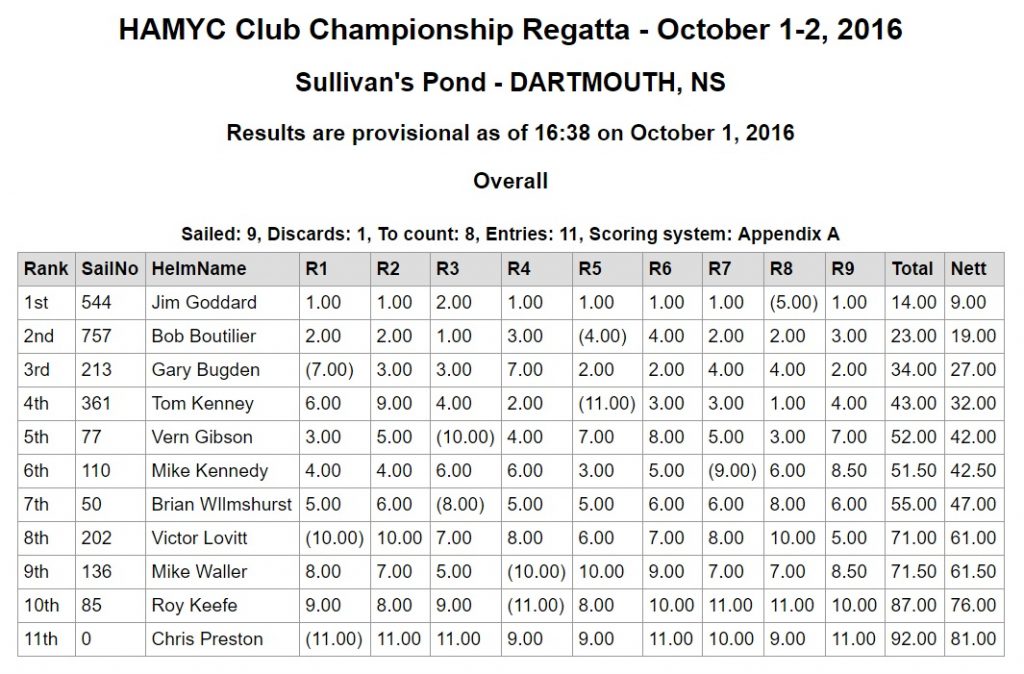
HAMYC Club Championship Final Results
Jim Goddard is the 2016 HAMYC Club Champion!

2016 HAMYC Club Championship – Final Results
HAMYC Club Championship Results after Day 1
US National Soling 1M Champions
Janice Anderson and Jim Goddard have made it a clean sweep of the US National Championships in the Soling 1M Class.
Janice won the first ever Women’s Championship in the class and Jim’s recent win in VT has created the unique result that both US Champions are Canadians from the same club.
Congratulations to both our winners, quite a result for a little club in Nova Scotia.

2016 US Soling 1M Nationals
The pond at Stowe had a bit of every wind condition for this years US Nationals. Friday had very light airs to start and were up and down in under 5mph range all day. A good number of sailors got Stowed throughout the day.
We started with two seeding races to establish three fleets for sailing. Several sailors scored well with two firsts in the seeding races including Jim Goddard of HAMYC. Three fleets sailing promotion relegation placed a premium on consistent top fleet finishes with a trip to the B or C fleet quickly adding points. At the end of Day 1, Jim Goddard led the regatta by a small margin.
Saturday had some light winds to start and with the exception of a few lulls provided a steadily building breeze with wild shifts. We sailed 18 heats or 6 races all on the same course! Wins in A fleet were spread around, and many sailors moved between the fleets. At the end of Day 2 with two drops available, Jim Goddard continued to hold a lead over the 30 boat fleet.
Sunday had wind and sometimes way too much wind causing a number of broaches both upwind and down. We sailed four races before the appointed end time, with Jim Goddard winning one race Sunday and solidifying the win with consistent A Fleet finishes.
The results do not show the high level of competition and close racing that took place in all conditions. Stowe threw everything at the fleet and we all had to cope with some tough, close racing.